
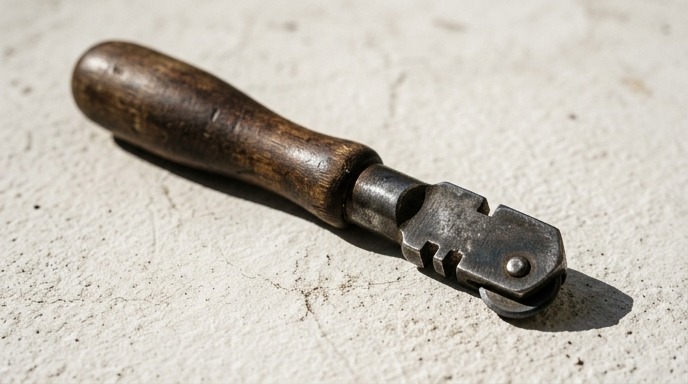
This is a glass cutter, also known as a glazier’s glass cutter. More specifically, the model shown is a Shaw glass cutter (England), designed for precisely cutting thin panes of glass.
The inscription “SHAW ENGLAND” is visible on the metal head, along with a rotating scale graduated from 1 to 6. This detail identifies it as an old professional tool, used in glass workshops.
What exactly is a glass cutter used for?
Contrary to what one might think, this tool doesn’t “cut” glass like a knife cuts food. It actually creates a line of weakness on the surface of the glass.
This fine incision creates a zone of weakness. Then, controlled pressure is applied to cleanly break the glass along the scored line. It’s a precise movement that requires skill and a steady hand.
How this tool works in practice
The operation is both simple and ingenious:
First, measure and mark the cutting line on the glass.
Then, use a ruler to guide the movement.
The glass cutter is held perfectly straight, then slid across the surface with even pressure.
A single continuous line is sufficient, without going over the same area multiple times.
Once the score is made, the glass can be broken cleanly by hand or with suitable pliers.
An essential tool in glasswork
The glass cutter is used in many areas related to glassmaking. It is particularly useful for:
cutting window panes
making or repairing frames
small carpentry and workshop tasks
It is an indispensable tool for obtaining clean and precise cuts on thin to medium-thickness glass. The traditional glass cutter remains a staple in specialized workshops.
An ancient tool still in use today
This type of glass cutter has existed since the 19th century, when wheel-type models began replacing older diamond-tipped tools. These new versions were simpler to use and, above all, more affordable.
Over time, the design has changed little: a wooden handle, a metal head, and a rotating wheel. This blend of simplicity and efficiency explains why this tool is still used today in some traditional crafts.
Why this object is so intriguing
What makes this tool so fascinating is precisely its mysterious appearance. Without context, it’s difficult to imagine its function. But once explained, everything becomes clear: each element has a specific role in the glass-cutting process.
It also reminds us how enigmatic some everyday professional objects can seem when taken out of their original context.
Ultimately, behind this mysterious object lies an ingenious tool, discreet yet essential in glasswork for generations. The traditional glazier’s tool still testifies today to the artisanal know-how passed down through time.
ADVERTISEMENT

