
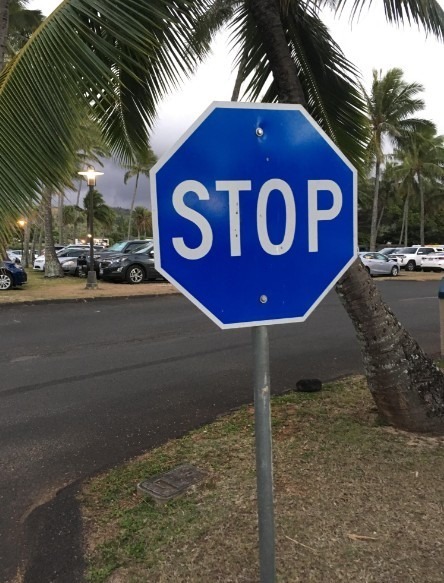
What a Blue Stop Sign Really Means (And Why It Exists)
First things first: real stop signs are never blue
On public roads, a stop sign is always red with white letters. This is not random—it is part of an internationally recognized traffic standard.
The red octagon shape is used because:
Red is highly visible and associated with danger or urgency
The octagon shape is unique and instantly recognizable even if partially obscured
Drivers are trained from early learning stages to respond to it immediately
So if you are driving on a regulated public road and see a blue “stop sign,” it is not an official traffic control device.
That’s the most important point.
So what is a blue stop sign?
When people encounter a blue stop sign, it usually falls into one of these categories:
1. Private property signage
The most common explanation is that the sign is placed on private property.
For example:
Parking lots
Private communities
Driveways
Industrial sites
Warehouses
Property owners sometimes install custom signs to guide traffic within their own space.
In these cases, a blue stop sign typically means:
“Please stop here for safety or control purposes within this private area.”
However, it is not enforced like a legal road sign unless local property rules apply.
2. Decorative or novelty sign
Some blue stop signs are purely decorative.
You might see them:
In gardens
In garages or man caves
In themed cafés or shops
As novelty gifts
These are often sold online or in stores for humor or decoration. They are meant to resemble official signage but are not functional traffic controls.
In this context, the blue color is simply a design choice to make the item look different or playful.
3. Internal facility instructions
In certain facilities, custom-colored signs are used for internal organization.
For example:
Airports (restricted service areas)
Military bases (non-public signage systems)
Construction zones
Large factories or campuses
However, even in these environments, a “blue stop sign” is not standard. Most official systems still rely on standardized traffic colors.
If blue signage appears in these places, it is usually part of an internal coding system rather than a legal instruction for public drivers.
4. Misinterpretation or unofficial modification
Sometimes people simply repaint or modify signs without realizing the importance of standardized traffic symbols.
This can happen when:
Someone reuses old signage materials
A sign is customized for aesthetic reasons
A DIY project imitates road signs
In these cases, the sign may look official but has no legal meaning.
Why Color Matters So Much in Traffic Signs
Traffic systems around the world rely heavily on color coding. This is not just for decoration—it is essential for safety and instant recognition.
see continuation on next page
To see the full cooking instructions, go to the next page or click the Open button (>) and don’t forget to SHARE it with your friends on Facebook.
ADVERTISEMENT
ADVERTISEMENT

